Congress Center
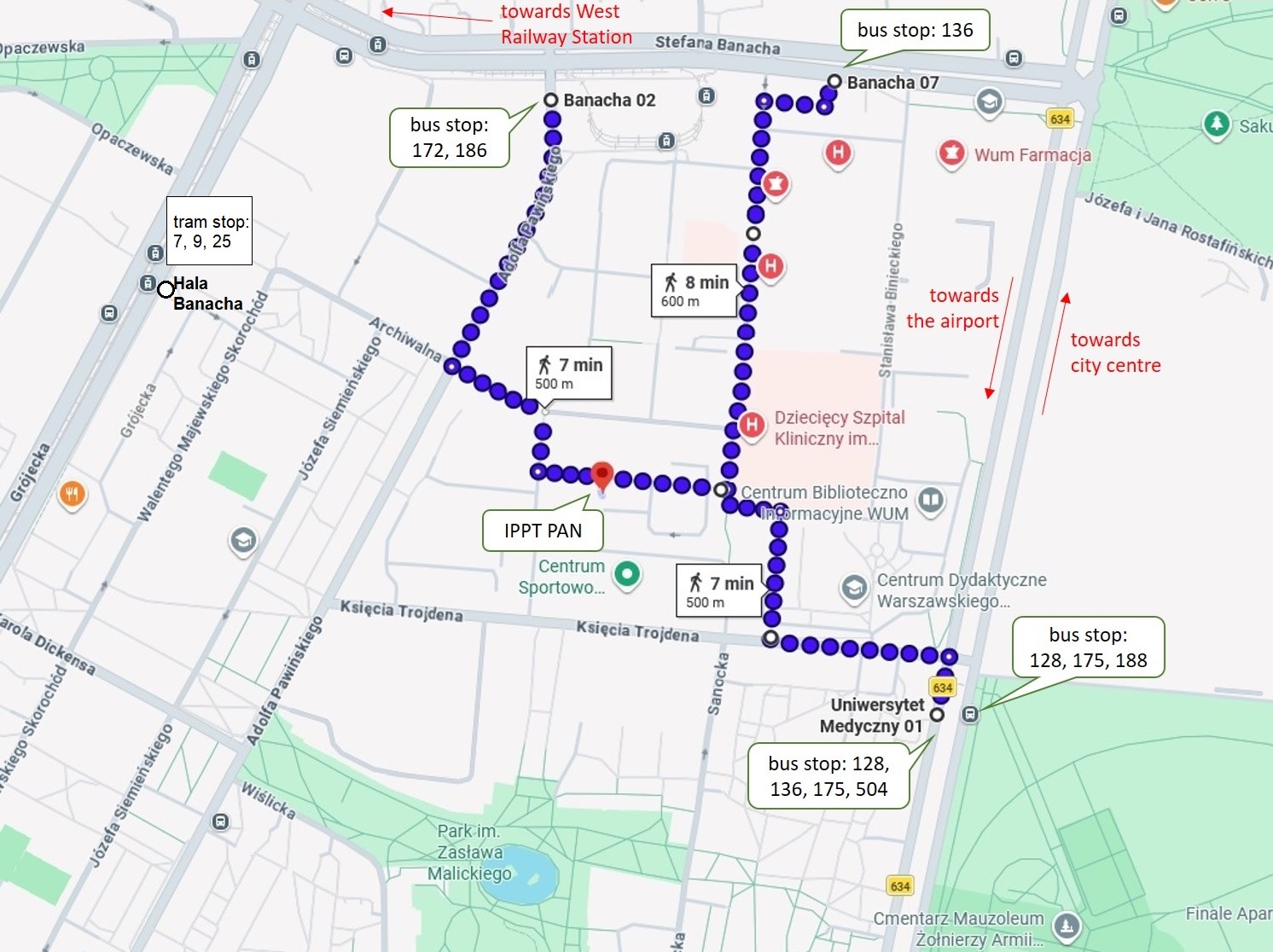
The AMBRA 2026 is supposed to be held at the Institute of Fundamental Technological Research Polish Academy of Sciences, about 20 minutes from the Warsaw Central Station and Chopin Warsaw Airport by public transport.
We are HERE
Address:
IPPT PAN
ul. Pawińskiego 5B
02-106 Warszawa
1. From Chopin Airport (WAW)
- Bus Lines: Take bus 175 (towards Pl. Piłsudskiego) or 188 (towards Gocławek).
- Stop: Get off at Uniwersytet Medyczny (~15-20 min).
2. From Central Railway Station (Warszawa Centralna)
- Bus Lines: Take bus 128 (towards Szczęśliwice) or 175 (towards Lotnisko Chopina) or 504 (towards Os. Kabaty).
- Stop: Get off at Uniwersytet Medyczny (~10-15 min).
3. From West Warsaw Railway Station (Warszawa Zachodnia)
- Bus Lines: Take bus 136 (towards Natolin Płn.) or 186 (towards Szczęśliwice) or 172 (towards Sadyba).
- Stop:
- For 136 get off at Banacha or Uniwersytet Medyczny (~10 min).
- For 186 or 172 get off at Banacha (~10-15 min).
- For 136 get off at Banacha or Uniwersytet Medyczny (~10 min).
Tickets
Public transport in Warsaw (WTP) is divided into two main zones: Zone 1 (covering the entire city area) and Zone 2 (surrounding suburbs).
|
Ticket Type |
Price (PLN) |
Validity / Zones |
|
20-minute |
3.40 PLN |
Zones 1 and 2 |
|
75-minute |
4.40 PLN |
Zone 1 |
|
90-minute |
7.00 PLN |
Zones 1 and 2 |
|
24-hour |
15.00 PLN |
Zone 1 |
|
24-hour |
26.00 PLN |
Zones 1 and 2 |
|
3-day (72h) |
36.00 PLN |
Zone 1 |
|
3-day (72h) |
57.00 PLN |
Zones 1 and 2 |
Key Details to Know:
· Validation: You must validate your ticket immediately after boarding a bus/tram or at the metro gate.
· Intermodal: Tickets are valid for buses, trams, the Metro, and SKM trains (urban rapid rail).
· Each type of ticket provides unlimited transfer.
· Discounts: Students with an ISIC card or individuals under 26 with a valid student ID are typically eligible for a 50% discount (Ulgowy).
· Where to buy: You can use ticket machines (at stations and on most vehicles), or mobile apps like Jakdojade, moBiLET, or SkyCash.
· Apps: It is recommended to use the Jakdojade app or website (available in English). It provides real-time schedules and tells you exactly which platform to stand on.
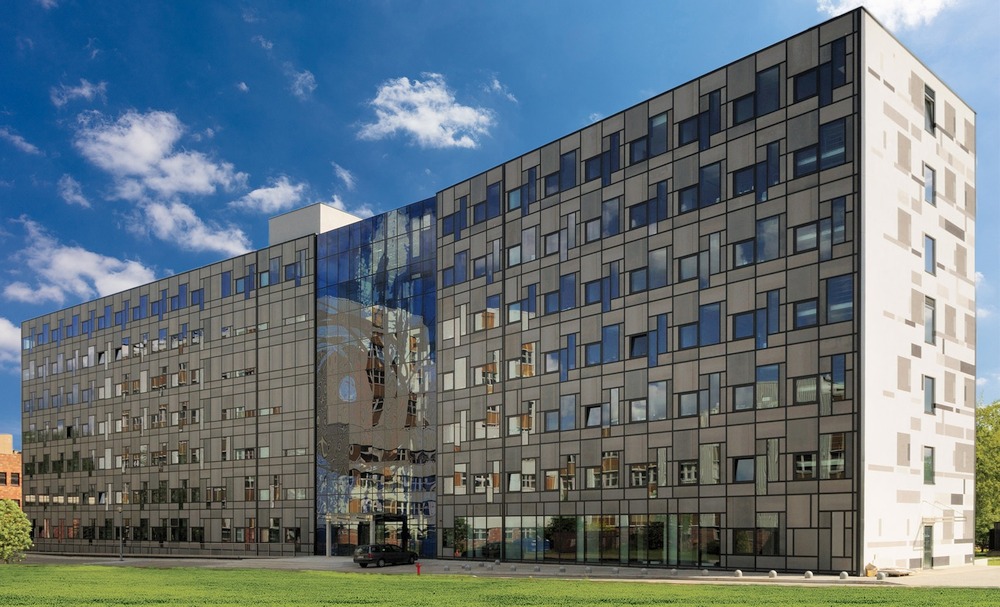
Institute of Fundamental Technological Research, Polish Academy of Sciences
Institute of Fundamental Technological Research (IFTR), Polish Academy of Sciences is the oldest and one of the largest research institutes of the Academy. Over more than 70 years of its history it has been the parent-institute of several spin-off institutes of the Academy (it has been for instance the place where the first Polish computers were built) and also nowadays with more than 300 employees, and a top research category A+, it is the core institute in the field of technical sciences. The researchers of IFTR PAS publish nearly 500 papers every year, including in the highest ranking journals such as Science. IFTR PAS has a wide research agenda aiming to bring recent developments in physics, chemistry, mathematics and computer science into a realm of real-life applications. Among its research subjects a prominent role is played by bio-engineering and materials engineering with a particular focus on nanotechnology. The institute is located in the south-west of Warsaw city-center, in Ochota district, and therein it is one of the key institutes in the Bio-Consortium Ochota of the Polish Academy of Science.
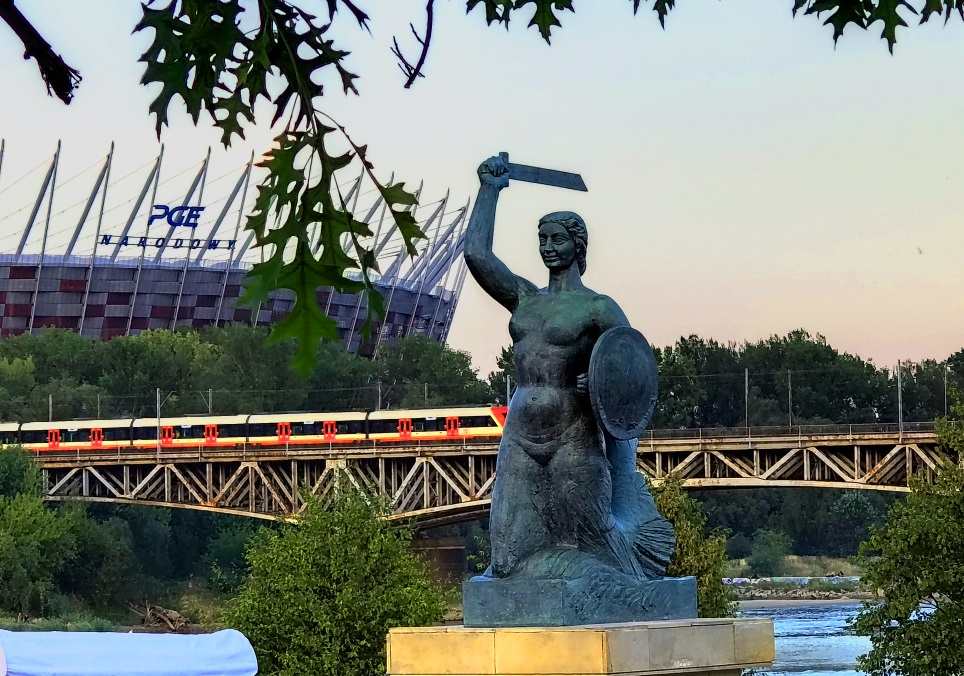
Warsaw
Warsaw, the bustling capital of Poland and the Mazovia province, is a vibrant city nestled in the heart of Europe. It's a fascinating blend of historical monuments, world-class museums, and sleek modern architecture. With nearly 40% of its area dedicated to parks and green spaces, Warsaw offers plenty of opportunities for relaxation and a connection with nature. This extraordinary city is a major academic, cultural, and economic center, drawing visitors from across the globe.
You can truly feel Warsaw's rich history in the Old Town, which dates back to the turn of the 13th and 14th centuries. Though completely destroyed during World War II, this heart of the Polish capital was meticulously reconstructed shortly after and is now a proud UNESCO World Heritage Site. While there, visit The Maria Skłodowska-Curie Museum on Freta Street, the world's only biographical museum dedicated to the double Nobel Prize winner.
For a more hands-on experience, head to The Copernicus Science Centre, one of Europe's largest science centers. Its exhibition boasts over 400 interdisciplinary experiments, interactive displays, and discovery zones covering various fields like physics, chemistry, biology, mathematics, and architecture.
Those interested in Warsaw's poignant past will find The Warsaw Rising Museum deeply moving. This interactive museum powerfully presents the realities of the heroic 1944 uprising.
And for classic music enthusiasts, the Fryderyk Chopin Museum, located in the beautifully restored Ostrogski Palace, is a must-see. Its interactive exhibition allows you to fully immerse yourself in the beautiful music of Poland's most famous composer.
For a captivating end to your Warsaw tour, visit The Royal Łazienki Park, a charming palace-and-garden complex, considered one of the most beautiful in Europe. Though its history dates back to the 17th century, it was king Stanisław August Poniatowski, Poland's last monarch, who, in 18th century, transformed Łazienki into the ravishing residence, that can be admired nowadays.
GALA DINER will take place at Bazyliszek restaurant (Old Town)
- Walk: Head to the Uniwersytet Medyczny bus stop.
- Bus: Take line 128 or 175 (direction: Plac Piłsudskiego).
- Exit: Get off at the final stop, Plac Piłsudskiego (~30 min).
- Walk: Head northeast toward the Old Town. Follow Krakowskie Przedmieście and Świętojańska Street to reach Rynek Starego Miasta 5/7.
The Legend of the Basilisk (Bazyliszek)
Legend has it that a royal lizard with a white spot resembling a crown lived in the basement of a dilapidated tenement house on Krzywe Koło Street, near the Market Square in Warsaw.
The basilisk was such a terrible monster that anyone who looked into its eyes died instantly.
Many brave men tried to face him, but even the bravest knights were unable to withstand the lizard's gaze.
The Old Town was freed from the Basilisk by a simple, clever shoemaker who bravely descended into the cellars armed only with a... mirror. The monster saw his own terrifying reflection and was defeated with his own weapon.
Over the years, Basilisk has changed its attitude - today it attracts and delights crowds of both Warsaw residents and tourists from all over the world.
The Old Town
Warsaw’s Old Town is a remarkable testament to resilience. Though it dates back to the 13th century, over 85% of its historic core was systematically destroyed during World War II. Its meticulous reconstruction using archival sketches and paintings was so successful that it became the first near-total reconstruction of a historic site to be added to the UNESCO World Heritage list.
Historical Landmarks & Sites
The Royal Castle in Warsaw is the centerpiece of the district, once serving as the official residence of Polish monarchs. It is famously the site where the Constitution of May 3, 1791 (the first in Europe, the second in the world) was signed. Visitors can tour the restored royal apartments and view original works by Rembrandt and Canaletto.
Sigismund's Column stands prominently in Castle Square. Erected in 1644, it commemorates King Sigismund III Vasa, who moved Poland's capital from Kraków to Warsaw. It is the city's oldest secular monument. Fragments of the original column, destroyed during the war, can still be seen lying nearby.
Archcathedral Basilica of St. John the Baptist is the oldest church in the city, featuring a unique Mazovian Gothic style. It serves as the burial site for many prominent Polish figures, including Nobel Prize-winning author Henryk Sienkiewicz and the last King of Poland, Stanisław August Poniatowski.
The heart of the district is the Historic Centre of Warsaw is a Market Square, surrounded by colorful tenement houses and bustling with outdoor cafés.
Mermaid Statue: At the center of the Historic Centre of Warsaw stands the bronze statue of the Warsaw Mermaid, the city's emblem and legendary guardian.
The Museum of Warsaw, located within several of the square's townhouses, provides a deep dive into the city's history and the stories of its inhabitants.
Wishing Bell on Kanonia Street located in a quiet square behind the Cathedral. Local legend suggests that walking around the bell three times while touching it will make your wish come true.
The Warsaw Barbican marks the boundary between the Old and New Towns. This 16th-century fortress is part of the original defensive wall system.
Nearby, the Mały Powstaniec (Little Insurgent) monument is a touching memorial to the child soldiers who fought during the 1944 Warsaw Uprising. It stands as one of the most emotional landmarks in the area.